
Consume the Art? Respect the Artist.
On Icebergs, Twelve Hours a day, and the Low Bar we Fail to Clear.
There's something we need to talk about — an honest conversation about something that's been sitting with me, and apparently needs to be said out loud.
If you consume art — in any form — you don't get to disrespect the people who make it.
That's it.
We could stop here. But since we clearly won’t, let’s chat.
The Invisible Iceberg
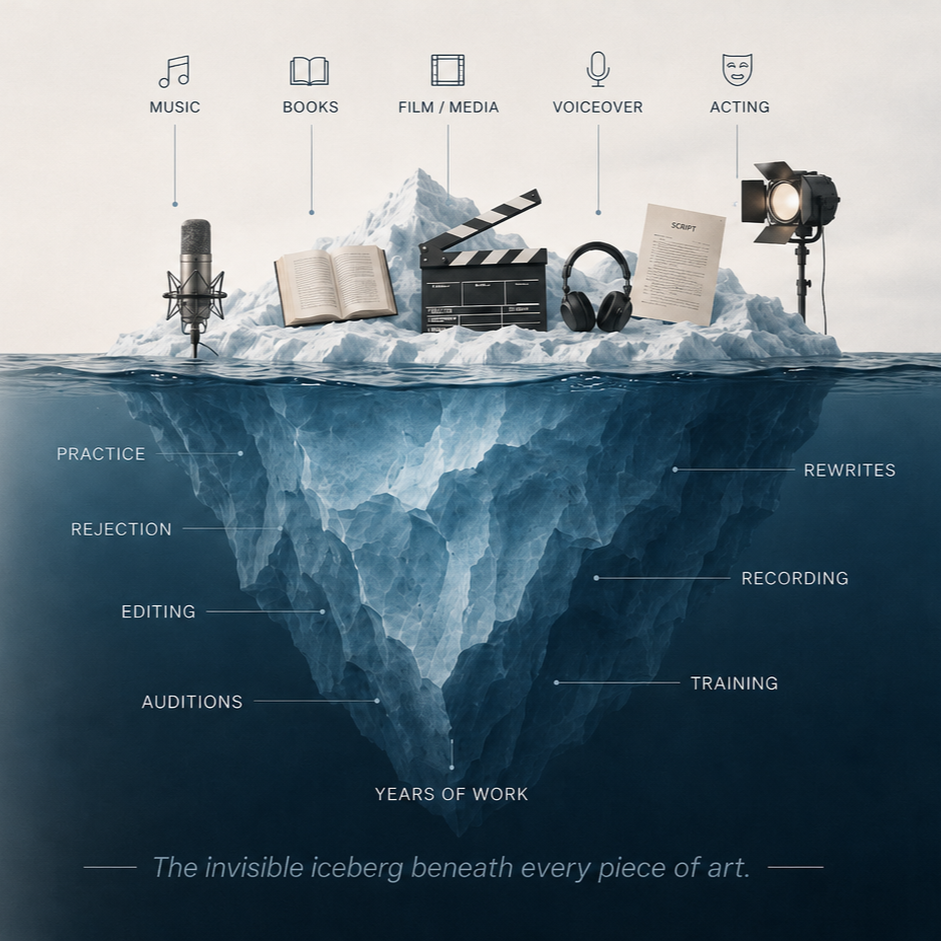
When someone hears music on the radio, watches a film, gets lost in a novel, escapes into a video game, or sits in a darkened theater watching a performer transform into character onstage — there's an invisible iceberg beneath that experience.
What you see (or hear, or feel) is the tip. What you don't see is the decade of training before the performer reached this moment. The years of unpaid gigs, rejected manuscripts, failed auditions, and 6 a.m. practice sessions before a survival job that actually paid the bills. The emotional excavation required to create something real enough that a complete stranger feels it and is moved by it.
Most professional artists began their craft in childhood. By the time they're performing for you, they've accumulated more hours of deliberate practice in their discipline than most professionals log in entire careers. And unlike many fields, there's no graduation day — no moment where a creative person says, “That’s it, I'm done learning now." The craft demands constant evolution. The industry demands constant reinvention.
That's not a hobby. That's a life's work.
The Consumption Problem
Here's where things get uncomfortable.
Americans now spend an average of over twelve hours a day consuming media — music, television, film, podcasts, books, games, and everything in between.
Twelve hours.
That's more time than some people sleep and work combined. Nearly every waking moment is, in some form, shaped by the creative output of artists.
And yet, the moment someone finds out that the musician, the actor, the author, the voice artist — that person — makes their living from that work, something curious happens. The respect evaporates. The comments appear. "Must be nice not to have a real job." "I wish I could just play around all day."
I'll be honest with you: if those comments are coming from a place of jealousy or resentment, I'd highly recommend exploring that with a professional. Because the math here is simple — you don't get to spend half your day being enriched by something and then turn around and call the person who made it lazy.
That's not just a contradiction. That’s hypocrisy.
The Simple Ask
I want to be precise here, because precision matters.
Artists are not asking for your approval. We are not asking you to like our work, to agree with our creative choices, or to think we're talented (though we don’t mind if you do). Criticism is part of the job. Honest critique is actually a gift.
What we're asking for is respect — which is a significantly lower bar.
Respect means acknowledging that a skill took time to develop. That someone dedicated themselves to something difficult and made themselves vulnerable in service of your entertainment or edification.
That the thing you're consuming — the song that got you through a messy divorce, the book that took you to a far away world, the video game that made you feel like a kid again, the performance that made you cry in a theater (and then pretend you weren't crying) — that thing didn't arrive fully formed from the void. A human being made it. On purpose. After years of effort.
I have genuine respect for the expertise it takes to do what you do. Whatever your profession is — whether you're building things, healing people, teaching children, running numbers, growing food — I respect the work behind it, particularly if I benefit from it. I think that's just basic human decency, and I try to extend it to everyone.
The simple ask is that respect flows in both directions.
The Experiment
Try this: spend one week without consuming any art.
No music — not in the car, not from a speaker, not ambient background sound in a coffee shop. No television. No films. No books or audiobooks. No podcasts with produced segments. No video games. No social media content from creators. No photography you didn't take yourself. No designed spaces, no curated playlists, nothing with a logo someone drew.
One week.
I'll save you the trouble: it's effectively impossible.
Art is not a luxury sector hovering at the fringes of real life. It is the texture of daily life. It's how we process grief, celebrate joy, make sense of confusion, connect with people we've never met, and remember who we are when we forget.
If you can live without it entirely, you've earned the right to be dismissive. Otherwise, perhaps a little acknowledgment is in order.
To Those Who Already Get It
If you're reading this and nodding — if you're someone who shows up for artists, who buys the thing instead of pirating it, who leaves the review, who tells someone their work mattered — thank you. Genuinely.
This wasn't written for you, and you probably already know that.
But if you've ever been the person who benefited from creative work and then questioned whether the person who made it "really works" — I'm inviting you to reconsider. Not out of guilt, but out of accuracy.
What artists do is real work. It is skilled work. It is work that shapes your inner life without you even knowing it, whether you acknowledge it or not.
You don't have to love every piece of art you encounter. You don't have to agree with every artist's choices or politics or personality.
You just have to accept the basic premise: the people who make the things you can't live without deserve the same dignity you extend to anyone else who's spent years mastering something difficult.
That bar is low. Almost anyone can clear it.
And the alternative? Giving up art entirely?
Good luck trying.